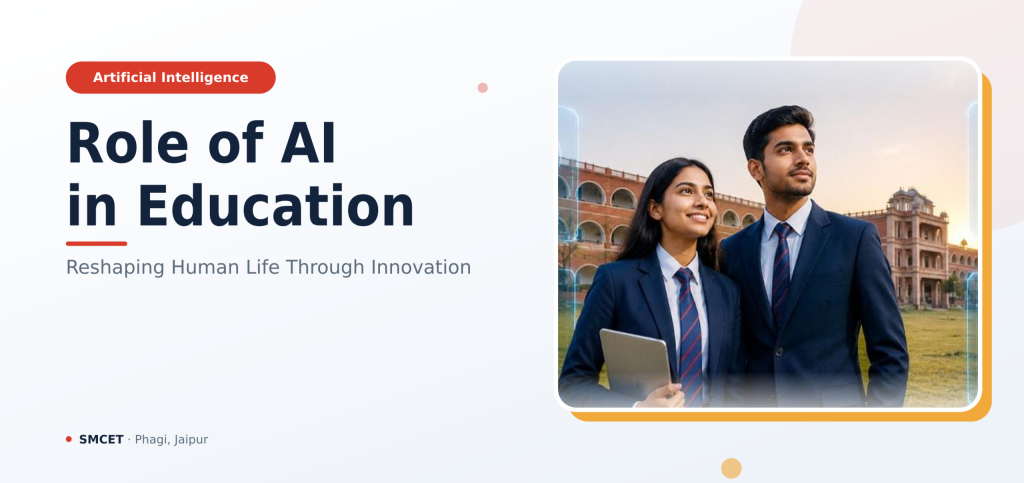
Role of AI in Human Life Through Engineering Education
Artificial Intelligence (AI) is changing the way in which people live, work, and interact with technology. Thanks to modern engineering education, AI is not only helping to advance various industries but is also altering everyday life by making systems smarter, quicker, and more efficient. Whether it’s the recommendations on your phone or the diagnostic tools used in hospitals, AI is already affecting most people’s daily routines without them being aware of it, and engineering colleges such as SMCET in Jaipur are educating the engineers who are responsible for building and maintaining these systems.
How Engineering Education Brings AI into Everyday Life
Engineering education is playing a key role in the integration of AI into everyday life; by teaching students things such as machine learning, data analytics, and automation, it enables future engineers to develop intelligent systems that deal with real-world problems, not just theoretical ones.
Such systems are currently being used in the field of healthcare for predicting diseases, in agriculture for enabling smart farming and for monitoring crops, in the transport sector for traffic control and for optimising routes, and in everyday life via virtual assistants, recommendation systems and smart devices. A decade ago, very few of these applications were available in a usable form, which is the reason why engineering courses have had to change rapidly in order to keep up with the technology that students will actually be working with.
Teaching Responsible and Ethical AI
Engineering education also makes it possible to develop AI in a responsible way; it teaches students about ethical issues, data privacy, and the social impact of intelligent technologies, so that they will create AI systems which are efficient, safe, and trustworthy for human use rather than systems that simply work.
It is important because AI systems can pick up biases from the data upon which they are trained or can be put to use in ways that were not originally intended. Engineers who understand these risks, not merely the mathematics of the models, are in a better position to identify problems before a system is launched, which is why ethics is considered a core subject rather than something added at the end.
AI is being used to improve education itself, not merely the industries that engineers later enter. By means of smart classrooms, personalised learning platforms, and virtual labs, the quality of engineering education is being enhanced since these arrangements adapt to the way in which each individual student learns rather than sticking to a single fixed pace for all.
Students are now able to learn at their own speed, make use of global resources, and obtain practical experience by means of simulations and the analysis of real-time data. SMCET is gradually incorporating this method into its teaching practices by combining digital tools with traditional lectures and lab sessions so that students may have the same kind of AI-assisted learning that is becoming standard in the industry.
Boosting Innovation and Entrepreneurship
The use of AI in engineering education also promotes innovation and entrepreneurship, as students are encouraged to create AI-based projects and, in some instances, to launch start-ups. This in turn contributes to economic growth and technological progress rather than merely preparing them for employment with one company. A wide range of career opportunities is now available in fields such as healthcare, finance, robotics, agriculture, and cybersecurity, since almost every industry is now seeking engineers who can apply AI to their particular area.
Why AI Skills Are in High Demand
Over the last few years, there has been a sharp increase in spending on AI-related technology, and this trend is being followed by the Indian industry as well, with sectors such as IT services, manufacturing, banking, and healthcare all currently employing engineers who have knowledge of machine learning and automation. The demand in this area is not only confined to the major metropolitan areas since companies are increasingly hiring people remotely or establishing regional development centres, so that engineers trained in places such as Jaipur are able to access many of the same opportunities as those available to people in the usual tech hubs.
For students, this means that there are more opportunities when it comes to entering the job market; since not every job involving AI calls for a background in research, many companies place the same value on engineers who can use existing AI tools to deal with real business problems as they do on those who develop new models from scratch.
AI Across Different Engineering Branches
AI is not seen by most people as belonging solely to the field of computer science, since it now has an effect in almost all areas of engineering. In the field of civil engineering, AI-powered sensors are employed for structural health monitoring, enabling the detection of the early indications of deterioration in bridges or buildings. In mechanical engineering, predictive maintenance systems make use of AI to predict when a machine component is likely to fail, thus decreasing unexpected downtime on a factory floor. In electrical engineering, AI is used to manage smart grids, making it possible to balance power supply and demand more efficiently throughout a city.
That is the reason why engineering colleges are now increasingly including basic training in AI and data among their students who are not pursuing pure computer science programmes, so that an engineering graduate in mechanics or civil engineering today has at least a practical understanding of how these tools can be applied in their own field.
Career Opportunities After Studying AI Engineering
A Bachelor of Technology degree in Artificial Intelligence Engineering provides a wide variety of career opportunities beyond the straightforward designation of “AI engineer”. Graduates go on to become machine learning engineers, data analysts, automation engineers, computer vision specialists, and AI product developers, working in sectors as diverse as banking, manufacturing, healthcare, and e-commerce.
Since AI skills are now required in nearly all branches of engineering, graduates who have a solid foundation in AI are often just as competitive when applying for positions in software development, robotics, and data engineering. It is for this reason that AI Engineering has become one of the fastest-growing options among B.Tech applicants in recent years, instead of remaining a narrow, one-track specialization.
Study Artificial Intelligence Engineering at SMCET, Jaipur
For anyone who wishes to take part in this transformation, SMCET provides a specialised B.Tech degree in Artificial Intelligence Engineering, a four-year course that focuses on machine learning, data analytics and automation, as well as the basic engineering subjects required by all branches. The programme is supported by approval from AICTE, affiliation with RTU, and has a placement network comprising more than 2,000 recruiters, enabling it to prepare graduates to design intelligent, real-world solutions in fields such as healthcare, finance, robotics and cybersecurity. The school also offers scholarships to eligible students, including special scholarships for women and those who have achieved merit, thus making the programme accessible to a broader number of applicants.
Conclusion
AI is becoming an essential element of human life, and engineering education provides the foundation upon which its growth and application can take place. By giving students the knowledge and skills needed in the field of AI, engineering education, just as institutions such as SMCET, is contributing to the creation of a smarter, more efficient, and sustainable future for society.
Frequently Asked Questions
1. Does SMCET have a specialist programme in AI engineering?
Yes, it does offer a four-year B.Tech degree in Artificial Intelligence Engineering, with the course covering machine learning, data analytics, and automation.
2. Do you need to have prior coding experience to join the AI Engineering programme?
No, the programme begins with some basic programming and mathematics before progressing on to machine learning and other subjects specific to AI.
3. What kind of jobs are available to graduates in AI Engineering?
They can take up positions such as machine learning engineer, data analyst, automation engineer, and AI product developer in sectors including healthcare, finance, and manufacturing.
4. When compared to Computer Science, is a career in AI Engineering a good choice?
Both are solid alternatives since AI Engineering places a greater emphasis on machine learning and data-driven systems, whereas Computer Science provides more extensive training in software development. The main subjects covered overlap in the first two years.
If you’d like to pursue a career in Artificial Intelligence Engineering, you can apply now for SMCET’s 2026–27 admissions or contact our Admission Helpline by phone at +91 8739 899 899.



 Mahindra
 Admission Helpline +91 8739 899 899